The AI Builder Opportunity
Most builders think the opportunity is "AI makes building faster." It's not. Read Vol 1 of The Builder Weekly. Mike Molinet & Govind Kavaturi interview operator-builders about expensive problems worth solving.
Mike Molinet & Govind Kavaturi

We’re Mike Molinet and Govind Kavaturi.
We’ve spent 15+ years building products and companies. Branch, then Thena, now building full-time again. We’ve shipped software, scaled teams, raised money, sold companies. We know how to build.
But here’s what we’ve learned matters most: knowing what to build.
Most builders never figure this out. They build impressive demos that nobody wants. They chase trends that fade. They solve problems that aren’t expensive enough to matter.
Right now, there’s a mega builder opportunity that most people are missing. It’s not about AI making you code faster. It’s about an entire category of problems that just became economically viable to solve.
This newsletter exists to show you that opportunity.
Every week, we interview one operator. Founders, VPs, Directors, team leads running functions at growing companies. We ask them what’s hard. What takes time. What’s broken. Then we publish what they told us and show you what to notice.
Not “here’s a problem, go build it.” But “here’s how to see the pattern of problems worth solving.”
This is Vol 1. Let’s start with what the builder opportunity actually is.
What Most Builders Get Wrong
Walk into any AI builder community right now and you’ll see the same thing:
People building image generators, calculators, guides, and checklist apps. Productivity tools for other builders. Demos that get 1,000 upvotes on Twitter and zero customers.
They’re optimizing for the wrong thing.
They think the opportunity is: “AI makes building faster, so build more things.”
That’s not the opportunity. That’s just noise.
The real opportunity is this:
For decades, there’s been a massive category of expensive, chronic problems inside companies that everyone knew existed but nobody could economically solve.
Not because the problems weren’t painful. But because building and running software businesses around them required too much. Infrastructure. Integrations. Maintenance. Support. Security. Compliance. Teams of 20+ people. Eighteen months to ship. Enough market size to justify venture funding.
The barrier wasn’t “can we build it?” The barrier was “can we run it as a business?”
Most problems weren’t big enough to justify starting a software company.
That constraint just disappeared.
Building in 2020 vs 2026
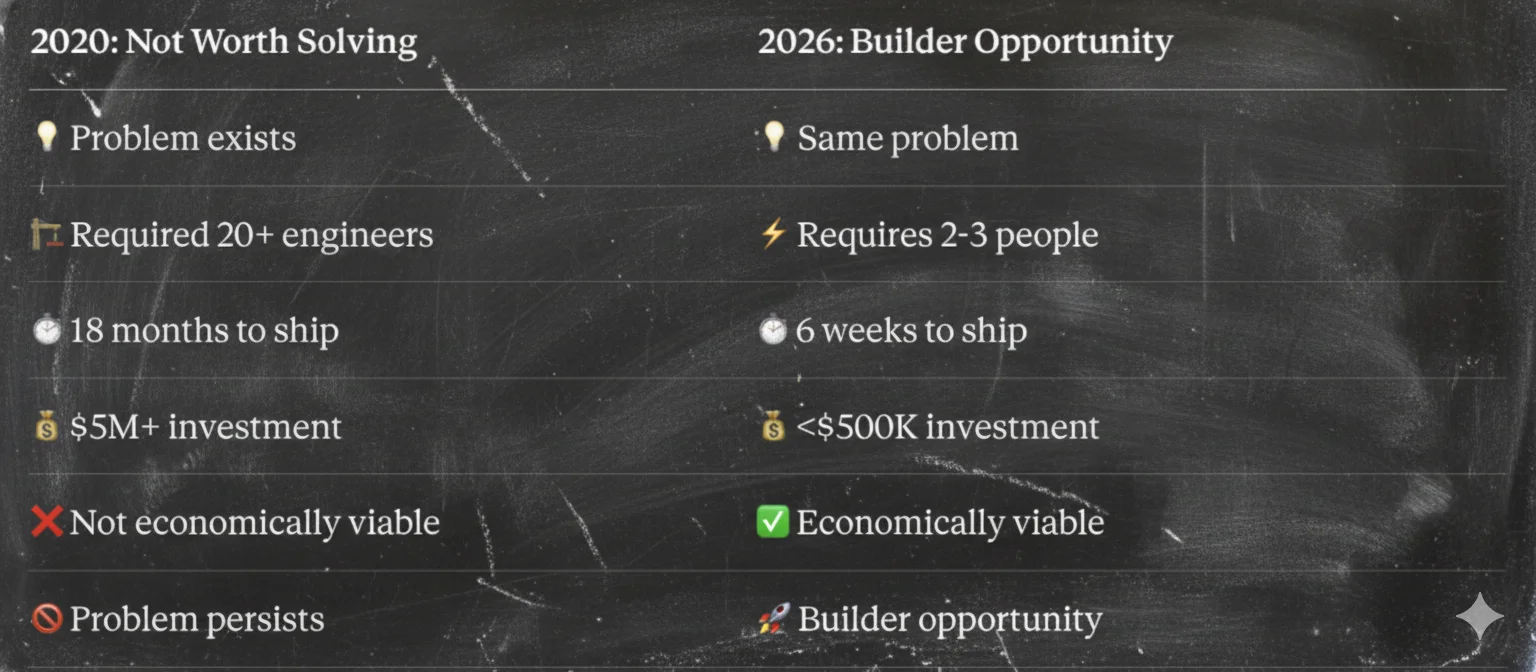
Image generated by Google Gemini
AI can handle complex, contextual logic. Modern infrastructure makes scaling trivial. Integration platforms connect everything. Small teams can operate software that used to require departments.
What changed isn’t that you can build faster. What changed is what’s now worth building at all.
There’s an entire long tail of expensive problems inside growing companies that just became viable. Problems that affect hundreds or thousands of companies, not millions. Problems that $3M-10M ARR businesses can be built around, not $100M+ venture outcomes.
The new game is different. Find expensive problems in growing companies. Build focused solutions to people. Sell. Scale without needing a massive org.
But you have to know how to see these problems. That’s the skill that matters.
What These Problems Look Like
Andrew Mewborn is a founder. Built a go-to-market engine that generates revenue with zero sales team. Former early sales leader at Outreach.
I'm not running a company. I'm running a testing lab. Every week I'm manually A/B testing emails - subject lines, hooks, body copy, CTAs. One variable at a time. Tracking it all in spreadsheets. Then doing it again. It's scientific method, but I'm the scientist, the lab tech, and the data analyst. I spend 10+ hours a week on work that should be automated.
Three examples from our conversation:
- We've lost deals where prospects tell us: 'We just signed with a vendor last week. We didn't even know you existed.' We weren't in the evaluation. There are 100 competitors now. Before, it was Outreach vs Salesloft. Pick one of two. Now there's 100 alternatives. How do you even get discovered?
- Everyone has a chat interface now. Everyone has a call recorder. Everyone has AI. So when I get a meeting, the first question is: 'How are you different?' But it's not just about features anymore. I have to educate them on the category itself. What AI can do. How to think about it. I'm not just selling my product. I'm teaching a class on AI tooling.
- I use Instantly for cold email. Rotating inboxes. But the tools don't actually help you test properly. They let you put in an A and a B version, but that's not a real A/B test. You're changing too many variables. I have a whole spreadsheet system: Week 1, test subject lines only. Week 2, test hooks only. Week 3, test body. Week 4, test CTA. I'm doing what e-commerce companies do with ads, but manually. Someone should build this. I don't have it in me to do another go-to-market product.
The Pattern
Andrew’s three problems are one problem: GTM infrastructure collapsing under its own weight.
When there were 2 competitors, GTM was simple. Build a good product. Do outbound. Get meetings. Close deals.
When there are 100 competitors, every step breaks:
- Discovery: You can't break through the noise
- Differentiation: Everyone has the same AI features
- Testing: Manual optimization doesn't scale
Andrew isn't building a company. He's being human middleware between his product and the market.
He's the discovery engine. He's the differentiation consultant. He's the testing platform.
Three years ago, fixing this meant hiring a sales team, a marketing team, a growth team. 15+ people. $2M+ in salary.
Today, 2-3 people can build software that does what Andrew's doing manually. AI handles the testing logic. Modern infrastructure makes it scalable. Integration platforms connect to every email tool.
The technical constraint is gone.
But most builders would still build the wrong thing. They'd hear “10 hours on A/B testing” and build another email tool.
Wrong. The problem isn't sending emails. The problem is systematic optimization of GTM in a crowded market. Email is just one channel.
This is the builder opportunity: GTM breaking under its own complexity. Founders becoming manual testing labs. Expensive, chronic work that AI can now eliminate.
Andrew isn't unique. Every founder at his stage has the same problem. Sales ops, customer success, marketing - same pattern everywhere. The tools exist. But they don't help you actually optimize. Humans fill the gap.
Why Most Builders Miss It
Most builders never see this because they’re not talking to the right people.
They’re in builder communities. They read about other builders. They build for other builders.
The opportunities aren’t in builder land. They’re in operator land. In founder land.
When you talk to an operator for an hour and actually listen, you hear specific signals:
“I spend X hours a week on...” “The information exists, but...” “Everyone asks me the same question...” “New people take forever to learn...” “It’s in five different places...” “The tools don’t talk to each other...”
These phrases mean someone is being middleware between systems. That someone is expensive. That work doesn’t scale.
That’s your signal.
You’re not looking for “I wish I had a tool for X.”
You’re looking for “I spend my time doing work that shouldn’t require a human.”
That’s the difference between a feature request and a real opportunity.
Andrew literally said: “Someone should build this.” That’s not market research. That’s a founder telling you exactly what’s missing.
The builders who win won’t be the ones building faster. They’ll be the ones who know where to look.
What This Newsletter Is
Every week, we interview one operator. Founders, VPs, team leads. We ask them what’s hard about their job. Where time disappears. What creates friction. What they’ve tried to fix and why it didn’t work.
Then we publish what they told us. Not sanitized. Not polished. Just honest conversation about where work breaks down.
This week was Andrew Mewborn, Founder.
Next week will be someone else. Different function. Different company. Same underlying pattern: systems breaking under their own weight, humans becoming the glue.
Over 50 weeks, you’ll develop intuition for what expensive problems look like. Not just “here’s a problem” but “here’s how to recognize this category of problem across different contexts.”
That’s the skill that matters. Learning to see what’s worth building.
We’re also building a community where operators and builders can connect. Where builders learn how to have discovery conversations. Where operators find solutions to problems they’re living with.
The opportunity is massive. Most builders won’t see it because they’re not talking to the right people.
This newsletter is how you learn to see it.
Join Us
If you’re a builder:
Stop building demos. Stop chasing trends. Start talking to operators.
The builders who see this opportunity will own the next five years. The ones who don’t will keep building things nobody wants.
We’re interviewing operators every week. Join our community. Learn how to have these conversations yourself. Get direct access to people who know where systems are breaking.
If you’re an operator or founder:
What takes 3+ hours of your week that feels like it shouldn’t require a human? What have you tried to fix that didn’t work?
Reply with one sentence. We’ll follow up. If we interview you, we’ll feature your insights here. Anonymous if you prefer.
The builder opportunity is real. It’s happening now. Most people are missing it.
Don’t be one of them.
Next week: Vol 2, another operator, another function, another pattern.
Mike & Govind
P.S. What Andrew Actually Needs
From our conversation, here are the specific tools Andrew mentioned that don't exist yet:
- Proper A/B Testing for Cold Email: Not “A vs B versions” but systematic single-variable testing with thresholds and automatic progression. Test subject line → hook → body → CTA. One at a time.
- Discovery in Crowded Markets: When there are 100 competitors, how do buyers even find you? The existing tools (SEO, ads, outbound) all assume you can break through. They can't.
- Differentiation Frameworks: Not positioning docs. Actual software that helps you articulate why you're different when everyone has the same AI features.