You're The Bottleneck
Intelligence isn't the problem. Coordination is. You built capable agents. Now build the layer that lets them work together.
Mike Molinet & Govind Kavaturi
Last week we talked about building the agent org. One agent doing everything is the bottleneck. Specialize. Create identities. Define handoffs. Share a common foundation.
This week: even with the org built, there’s another bottleneck. You.
The Setup
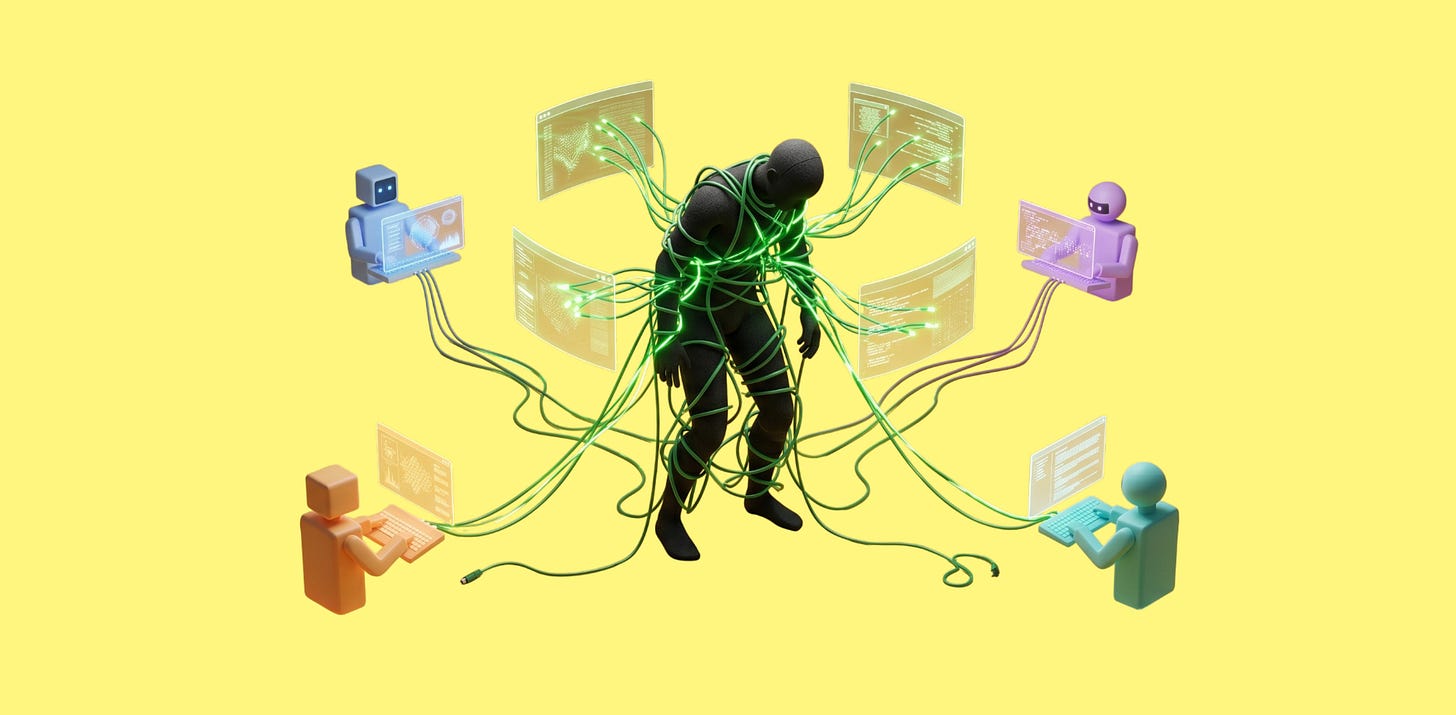
Eight AI agents. All individually capable. None of them talking to each other.
The bottleneck isn’t intelligence. It’s the human sitting in the middle, copying context between windows.
You’ve become the middleware between your own tools.
What The Day Actually Looks Like
Agent A finishes a research brief. Pings you. You read it, pull out what matters, paste it into Agent B’s window.
Agent B drafts something. You review it. Realize it needs data from Agent C. Copy that. Bring it back.
Agent C needs context from Agent A’s work. But Agent C doesn’t know Agent A exists.
You’re not doing work. You’re routing messages between things that do work.
The agents don’t share state. They don’t talk to each other. They have no idea the others exist.
The only shared context in the entire system is you.
This Problem Is 2,000 Years Old
The Roman Army organized into groups of eight soldiers, led by one guy. Ten groups made a century. Six centuries made a cohort. Ten cohorts made a legion.
At every level, a commander aggregated information from below and relayed decisions from above.
The structure existed because one human can effectively coordinate three to eight other humans. That’s it. That was the entire constraint.
The Prussian military formalized it after Napoleon destroyed them. They invented the General Staff. Officers whose job wasn’t to fight but to route information and maintain alignment.
This was middle management before the term existed.
Railroads borrowed the playbook. Every corporation still runs on it.
The fundamental constraint hasn’t changed in two millennia: humans need layers to coordinate, and those layers slow everything down.
The question was never whether you needed layers. The question was whether humans were the only option for what those layers do.
For two thousand years, the answer was yes.
It might not be anymore.
The Org Chart Nobody Would Design
Imagine a team where every person reports directly to one manager.
No shared tools. No cross-functional communication. No project management system.
Just eight people doing their jobs in isolation. One person holding the entire context graph in their head.
Nobody would design a team this way. You’d look at it and say this doesn’t scale. That one person becomes the constraint. The team’s output is capped by one person’s bandwidth.
That’s what you’ve built with your agents.
The agents are the team. Capable. Fast. Increasingly autonomous.
But the coordination layer between them is you. Clicking between windows. Remembering which agent has which context. Manually bridging every gap.
Intelligence Isn’t The Bottleneck
The AI industry is pouring billions into making models smarter. Bigger context windows. Better reasoning. Faster inference.
That stuff matters.
But the constraint most people hit isn’t intelligence. The agents are smart enough. The code agent writes decent code. The research agent finds real insights. The content agent drafts things you can use.
The constraint is plumbing.
No shared state layer where Agent A’s output becomes Agent B’s input.
No event system where finishing one task triggers the next.
No way for agents to ask each other questions without routing through you.
YC’s Summer 2026 Requests for Startups calls this out directly. One category is “Company Brain.” Their framing: the biggest blocker to AI automation is no longer the models. They got good fast. Now the blocker is domain knowledge and coordination.
Not smarter agents. Better plumbing.
The Copilot Trap
Most organizations using AI are giving people copilots. A coding assistant. A writing helper. A research tool in a browser tab.
That makes the existing structure work slightly better without changing it.
You’ve made each node in the network smarter. But the network topology is identical.
The same human routes information between the same siloed tools. You just made each tool faster at the thing it already does.
It’s the difference between giving every soldier a better sword versus replacing messengers on horseback with radios.
One is incremental improvement to what exists. The other changes how coordination works.
Most people running AI agents are in the better-sword phase. Each individual agent is capable. The coordination model hasn’t been touched.
The People Furthest Ahead Built Their Own
Garry Tan is shipping 40+ features in 60 days. Part-time. While running YC full-time.
He built a system called gbrain. A self-wiring knowledge graph where his agents ingest meetings, emails, tweets, and voice calls while he sleeps. 21 autonomous cron jobs.
He built the coordination layer himself because it doesn’t exist as a product.
When the most connected person in the startup ecosystem has to build his own agent plumbing from scratch, the infrastructure gap is real.
Diana Hu’s Startup School slides are blunt:
“Make your company queryable. Every action produces an artifact the system can learn from.”
“No more human middleware. Your velocity is only as fast as your information flow. Every layer of human routing you remove is a direct speed gain.”
What The Coordination Layer Needs
At minimum:
Shared state. Agents read each other’s outputs without human copy-paste. Agent B sees what Agent A produced. Automatically.
Event bus. Completing one task triggers the next. No human clicking “now do the next thing.”
Identity and permissions. Agents interact with each other’s tools directly. Not everything through you.
Context protocol. Agent C pulls what Agent A learned two hours ago without you relaying it.
Think less “AI platform” and more “infrastructure primitive.”
The way S3 solved storage or Stripe solved payments. Not the application on top. The plumbing underneath that makes applications possible.
Early pieces exist. Google’s A2A protocol. Anthropic’s MCP. Startups working on agent communication layers.
But the full coordination fabric? The thing that lets six agents on different platforms share state, trigger workflows, and resolve dependencies without routing through a human?
It barely exists.
The people furthest ahead are building their own with duct tape and cron jobs. That’s usually the sign an infrastructure layer is about to emerge.
The Framework
Stop being the middleware.
Step 1: Map your current routing.
Where are you copying context? Where are you the bridge between agents? Write it down. Every copy-paste. Every “let me grab that from the other window.” That’s the map.
Step 2: Identify shared state needs.
What does Agent B need from Agent A? What does Agent C need from both? Draw the dependencies.
Step 3: Build the artifact layer.
Every agent output becomes a document, a log, a state file. Something other agents can read without you forwarding it.
Step 4: Create triggers.
When Agent A finishes, what should happen next? Automate the handoff. Cron jobs. Webhooks. Whatever works. Remove yourself from the sequence.
Step 5: Move to the edges.
Vol 10: Humans belong at the edges. Intent. Verification. Exceptions.
Not in the middle routing messages. You set direction. You verify outcomes. You handle the exceptions.
The middle is plumbing. Get out of it.
The Diagnosis
You’ve proven individual agents can do real work. That debate is over.
The next question isn’t whether agents are useful. It’s whether they can work together without a human manually stitching every interaction.
Right now, they can’t. And the people who’ve gone deepest on AI agents, across every role, every industry, are all hitting the same wall.
The bottleneck isn’t intelligence. It’s coordination.
And right now, the coordination layer is you.
Vol 1: The opportunity exists. Economics changed.
Vol 2: Smart operators doing dumb work. Patterns to spot.
...
Vol 14: Build the agent org. One agent is the bottleneck.
Vol 15: You’re the bottleneck. Intelligence isn’t the problem. Coordination is.
You’ve built capable agents. Now build the layer that lets them work together.
Where are you still the middleware?
If this was helpful, check out the original article at AI Drop Daily.
Mike & Govind
Running multiple agents? Map where you’re copying context between them. That’s your bottleneck. Start there.