The Filter Isn't Building Anymore
A million products will launch. The builders who win won't be the ones who ship fastest. They'll be the ones who find the lake, earn the trust, and sell clean floors instead of electric motors.
Mike Molinet & Govind Kavaturi
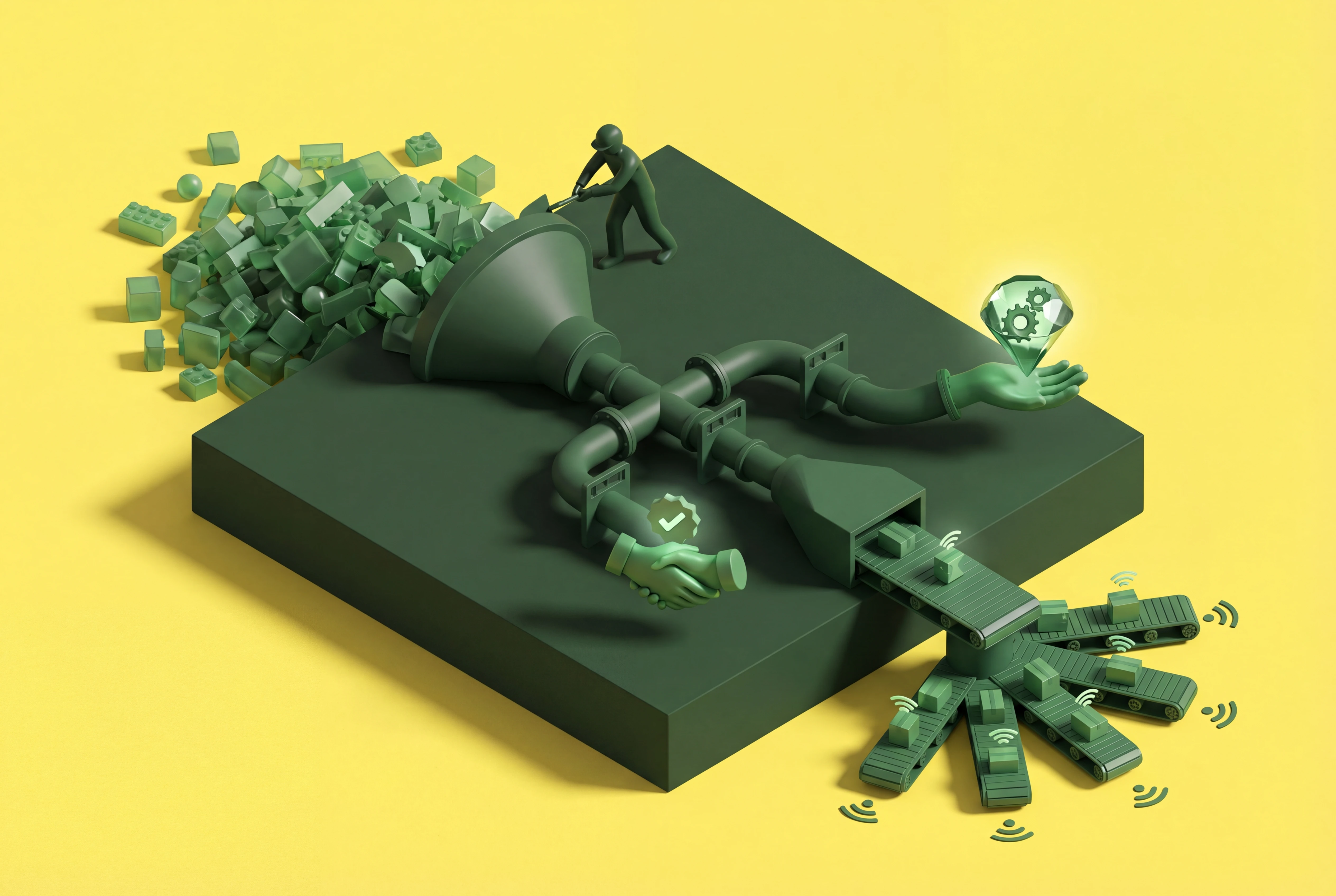
Everyone can build now. The filter is distribution, trust, and selling the outcome — not the AI label, not the demo, not the launch.
Maor Shlomo hit $100M ARR as a solo founder. No VC. Built most of the code himself using AI tools. His post about it was two sentences long and ended with the word "emotional."
That number traveled fast. It became a screenshot. A retweet. A permission slip for every builder who ever wondered whether one person could do it alone. And the answer, now, is obviously yes. One person can build a $100M company.
But that fact, by itself, is the wrong thing to focus on.
The interesting question is not whether one person can build something massive. Maor proved that. The interesting question is what happens when a million people try. Because that is exactly what is happening. Build time collapsed. Team size collapsed. Time to revenue collapsed. Anton Osika built the first version of Lovable in a weekend. That company is now worth $6.6 billion. Cursor hit $100M ARR with 12 people. Lovable hit $100M ARR with 45. Stripe's 2025 data showed twice as many startups reaching $10M ARR in three months compared to the year before. Twenty percent charged their first customer within 30 days. Up from eight percent in 2020.
Building is no longer the bottleneck. Everyone has access to the same models. The same tools. The same weekend-to-prototype pipeline. Which means building is no longer the filter.
So what is?
Three things emerged this month that answer that question. And they stack on top of each other in a specific order.
First: distribution. Steven and Cesare left eight-plus-year management careers at a VC-backed company. Sold to an Australian competitor, stayed on, quit. They chose bootstrap. Built a product called Job Alert over a year ago. Forgot about it. Discovered it again when the domain renewal email showed up. Then they did something most builders skip. They distributed it. Reddit. Got banned ten times before they figured out how to bring value before pitching. Hit $2.5K revenue and roughly $1K MRR in under two months.
Their lesson was blunt. Find the lake, then build the rod. They used to walk around with a hook looking for water. Now they find where the fish are and decide what to build. Wrong order: build the product, find the audience, hope for traction. Right order: find the audience, understand the problem, build the solution, launch to people already waiting.
Cesare spent 20 years in product. His validation framework collapsed into one sentence. There is nothing that validates more than a payment. Not waitlists. Not questionnaires. Not interviews. A Stripe notification is validation. Everything else is noise.
One million products will launch in the next 24 months. Most will fail. No distribution. No audience. No lake. But 10,000 of those will hit $1M ARR. The math works now. $1M ARR is 84 customers paying $1,000 a year. Or 834 paying $100. Those are achievable numbers for a solo founder who found the right lake before they built the rod.
But finding the lake only gets you in. Staying in is the second filter.
Trust.
Your users changed. You are not just building for humans anymore. AI agents are already choosing tools. Picking APIs. Selecting products. Not based on marketing. Not based on brand. Based on what works. A human user hits a bug. Maybe they refresh. Maybe they email support. Maybe they complain on Twitter. You have time. You have signal. An agent hits a bug. It calls the next API on its list. Never comes back. No feedback. No warning. No second chance.
For two years, users tolerated flaky AI products. "It's AI, it's not perfect." That grace period is ending. Users have seen what good looks like. The bar is rising. And agents never had a grace period to begin with.
Reliability is not a feature you add later. It is the feature. The builder who ships a slightly worse capability but never goes down will beat the builder who ships the best capability but breaks twice a month. Trust compounds. Features don't. A user who trusts your product tells other users. An agent that trusts your product tells other agents. A user who got burned once is gone. An agent who got burned once is gone and never coming back.
Silent failures are the killer. A background job stops running. No error. No alert. Just the absence of output. An AI response is confidently wrong and the user does not know enough to question it. A scheduled task fires but produces garbage and the logs say success. By the time someone notices, trust is broken. The builders who build feedback loops catch these failures early. The builders who don't find out from silence.
So distribution gets you users. Trust keeps them. And the third filter determines whether any of it converts in the first place.
Stop selling AI.
Look at any Product Hunt launch right now. "AI-powered." "AI-native." "Vibe coded." That is like selling "powered by electricity" in 1920. Nobody cares. They care what it does. The vacuum cleaner did not sell "revolutionary electric motor technology." It sold clean floors in minutes. The iPhone did not sell "ARM processor with multi-touch capacitive display." It sold 1000 songs in your pocket.
In 2023, saying "we use AI" was instant interest. In 2026, it triggers skepticism. Hallucinations. Wrong answers. Overpromised. Underdelivered. Users have been burned. The label that used to attract now repels. Worse, everyone has it. Claude Opus 4.6, ChatGPT 5.4, Replit Agent 4. The models are commoditized. Saying "AI-powered" is like saying "cloud-based" in 2015. Table stakes.
The rewrite is simple. "AI-powered scheduling assistant" becomes "Never miss a meeting. Never double-book. Your calendar manages itself." "AI customer support platform" becomes "Tickets resolved before your team wakes up. 99.9% accuracy. Zero burnout." The AI disappeared. The value appeared.
Here is the exercise. Go to your landing page. Count how many times you say "AI." Now ask what you would say if you could not use the word at all. That is your real pitch.
These three filters stack. Distribution gets you in front of users. Trust keeps those users from leaving. Selling the outcome instead of the motor is what converts attention into revenue in the first place. Miss any one of them and you are part of the 990,000, not the 10,000.
Maor Shlomo did not hit $100M because he used AI tools. Everyone has AI tools. He hit it because he picked one problem, went deep, maintained what he built for years, and delivered something that worked. He found the lake. He earned the trust. He sold clean floors.
The highlight reel is one number and two sentences. The reality is years of agentic debt cleaned up, context switching fought against, API research done before the first line of code, and a steady state goal where the system runs without being touched.
The ceiling collapsed for teams. The floor rose for solo founders. Building is free. Launching is free. The filter moved.
What are you actually selling?
We are watching what happens when agents start choosing products at scale. Not agents as demos. Agents as buyers. The shift from human users tolerating flaky tools to agent users silently routing around them is happening faster than most builders expect. We are also watching the solo founder cohort closely. Not the ones hitting $100M. The ones hitting $1M. The thousands of builders who found a lake, built a rod, and got their first Stripe notification. Those stories are quieter but they tell you more about where this is going than any headline number. The question we keep coming back to: what does the product stack look like when your primary user is not a person but a system making decisions on behalf of a person? The builders answering that question right now are building something different. We want to find them.
The $100M Solo Founder
The grind behind the highlight reel. Maor Shlomo hit $100M ARR as a solo founder using AI tools. Mike Molinet & Govind Kavaturi break down what it actually takes — agentic debt, context switching, API research, and the steady state goal.
Read the issue →The Launch Economy
1 million products will launch. 10,000 will hit $1M. The filter is distribution.
Read the issue →Trust Is The New Moat
Your users are humans and agents now. Both demand reliability. One is less forgiving. Mike Molinet & Govind Kavaturi break down why trust — reliability, security, transparency — is the new competitive moat in the agent economy.
Read the issue →Stop Selling AI
Sell the outcome, not the motor. Everyone is screaming 'AI-powered' — users are tuning it out. Mike Molinet & Govind Kavaturi explain why the best builders sell clean floors, not electric motors.
Read the issue →