The Hard Parts Have Moved
Five weeks of writing answered the same question five different ways. What used to slow builders is solved; what slows them now is the discipline to use what's solved.
Mike Molinet & Govind Kavaturi
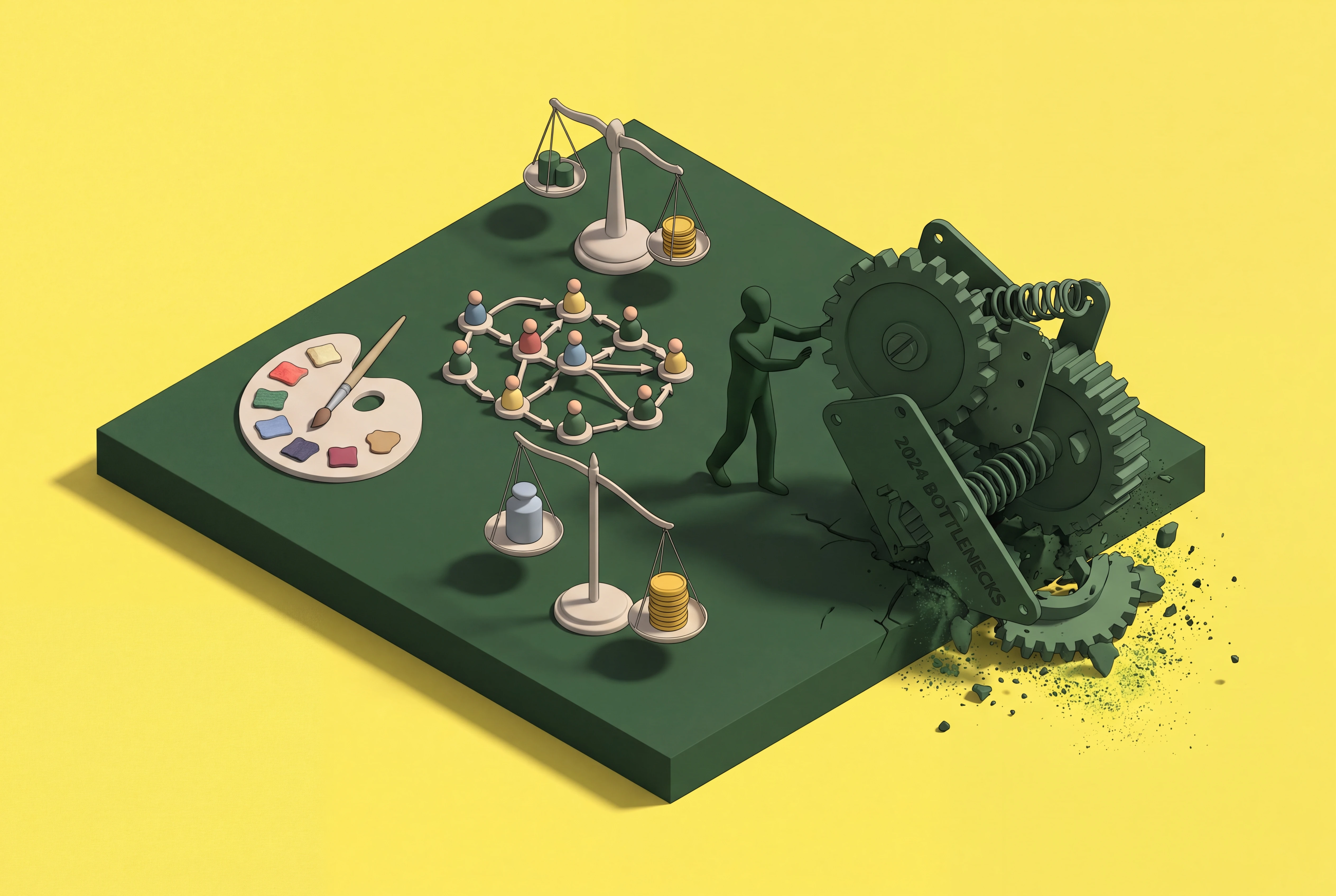
Every bottleneck that held builders in 2024 was solved this month. The new constraints are taste, org design, and pricing discipline. The hard parts moved.
Anthropic raised $50B. OpenAI raised $122B the week before. The Claude Pro Max plan at $200 a month is gone. If you were running a small team on it, your bill just became closer to $2,000. Maybe more.
Those numbers are not a war chest. They are the price of telling the truth about what inference costs. For two years, every builder who wired a product to a frontier model was running on a balance sheet that wasn't theirs. Anthropic and OpenAI ate the difference between what the call actually cost and what they charged for it. The trade made sense for them while market share was still being decided. Now the round closes, the spreadsheet opens, and the prices rise to meet the math.
The same week that subsidies ended, the design constraint ended too. Claude Design shipped a system that produces brand systems, layouts, and motion in the time it takes to describe what you want. The work that used to require a $20K agency engagement is now a prompt and an hour. Last month, having a great-looking product was a competitive moat. This month it is the floor. Everyone has access to the same generator. Everyone's landing pages can look like they were art-directed by someone with taste. The differentiator moved from whether your product looked good to whether someone has a reason to choose yours over the four other versions of it that also look good.
The same week as that, the single-agent ceiling broke. A solo founder running ten products used to mean one agent, one chat window, one human routing context between tasks. The model worked for a quarter, then started to crack. Specialized agents organized like a company scaled past the ceiling. Each agent gets a name. A role. A scope of authorization. Its own context. Its own growth path. They share a foundation: product knowledge, voice, operating rules. They hand work to each other through defined boundaries. This is what an org chart was for. The new version uses agents instead of headcount.
And the week before that, the question of what humans do at all got an answer. The frame was edges. Humans handle intent (deciding what to build), verification (catching what the system gets wrong), and exceptions (the cases the system was never designed for). Everything in between is the agent's job. The ratio one engineer named: 95 percent of the contributions to a major open-source codebase in the last 30 days were written by Claude Code. The human wrote the 5 percent that mattered. That is the new ratio. That is what the role of an operator becomes when the middle of the stack is delegated.
Four structural moves in four weeks. Subsidy economics broke. Design democratized. Single-agent ceilings shattered. Human work concentrated at the edges. Each one removed a constraint that was real a quarter ago. Each one replaced it with something subtler.
If you spent April reading announcements, the impression was that everything got easier. If you spent April building, the impression was the opposite. Every bottleneck the cycle solved revealed a new one underneath. The new ones are harder to name and harder to delegate.
Subsidy economics ending means margin discipline. If you priced your product against $200-a-month all-you-can-eat inference, your unit economics are about to feel like 2008. The builders who survive this are the ones who priced for a world without subsidies from day one. The builders who burn are the ones who confused customer-acquisition spend by a vendor with a sustainable cost structure of their own. The new constraint is: do you know what your inference actually costs, and is your price more than that? If you cannot answer that in one number, you do not have margin discipline. You have hope.
Design democratized means taste. Anyone can produce a competent landing page now. The five competing products in your category all look fine. The thing that makes a buyer choose yours has to come from somewhere. It comes from editorial choice: which features get the foreground, which paragraphs get cut, which animation gets removed because it adds friction the page doesn't need. Taste is the unfair advantage when everyone has the same tools.
Multi-agent specialization means org design. One agent doing everything is the easy mistake. Building the agent org means naming roles, assigning authority, defining handoffs, and writing the shared foundation that bonds them. That is not a model problem. That is an operating system for work. The builders who do it well in 2026 are the ones who already know how to design a real company. The builders who skip it stay capped at what one operator plus one general-purpose agent can hold in working memory.
Human work moving to the edges means knowing which edges. Intent, verification, and exceptions sound clear in writing. In practice they require you to decide what is worth verifying and what isn't. To set the bar for an exception that fires an alert versus an exception that gets handled silently. The phrase that kept surfacing: if you cannot rollback in under five minutes, you are not ready for production. That is the same idea as edges. The middle automates. The boundary is yours.
These four shifts share a structure. The old constraint was technical. The new constraint is editorial. Whether you can build a thing has been answered. Whether you should build a thing, the way you build it, the layer of the system you guard, and the price you charge for it remain. Those are taste questions. They cannot be prompted. They were always the work. They were obscured by the cost of getting to them. The cost is gone now. The work is more visible than ever.
Builders who treat April as a permission slip will ship more products faster and have less to show for it. Builders who treat April as a relocation notice will build fewer, slower products that hold up.
The hard parts have moved. The names of the hard parts changed. The work of being a builder did not.
We're watching whether April's relocations stick or if they get rolled back in May. The subsidy question is the cleanest tell. If Anthropic or OpenAI announces a new low-tier consumer plan that brings $200-a-month inference back, we know they don't actually believe in their own pricing. If the prices hold, we know the era of building on rented economics is finally over. We are also watching the design democratization curve. Claude Design works, but every builder gets the same output by default. Whether the people who paid the most attention to brand discipline before this month maintain their lead, or whether the lead gets compressed because everyone now has access to the same baseline, is the question that decides whether design is a moat or a floor. Both answers are interesting. Neither is decided yet.
The Human At The Edges
Not everywhere. Not nowhere. At the edges. Mike Molinet & Govind Kavaturi explain where humans belong in AI workflows: intent, verification, and exceptions. The middle is the machine. The edges are you.
Read the issue →The End of Subsidized AI
The subsidy era is ending. The intelligence era is beginning. Mike Molinet & Govind Kavaturi break down what Claude dropping token subscriptions and Anthropic's Mythos model mean for every builder's margins and strategy.
Read the issue →AI Alone Is Fragile
Your demo works. Your production is fragile. Build the system, then build the product. AI executes within a system. Without one, you ship fragile. With one, you ship with confidence.
Read the issue →Design Is Not Your Problem Anymore
Claude Design just removed the last real barrier to shipping beautiful products. When everyone can design, beauty is baseline. The new work is standing out.
Read the issue →Build The Agent Org
One AI doing everything is the bottleneck. Build the agent org. Specialized identities, shared foundation, real handoffs. How 2-3 people scale to what used to take 20.
Read the issue →