AI Alone Is Fragile
Your demo works. Your production is fragile. Build the system, then build the product. AI executes within a system. Without one, you ship fragile. With one, you ship with confidence.
Mike Molinet & Govind Kavaturi
Last week we talked about the end of subsidized AI. The subsidy era is ending. The intelligence era is beginning. Build for real costs.
This week: the mistake that kills most AI builds before they reach users.
The demo trap
Everyone is building fast right now.
Claude writes your code. Cursor autocompletes your thoughts. Lovable ships your UI. Replit Agent builds the whole thing.
Demo ready in a weekend. Looks great. Works in the video.
Then you try to take it to production.
It breaks. It hallucinates. It fails silently. Users leave.
Here is the thing. Building a demo is important. It is how you validate the vision works. It is the experimental phase. Do not skip it.
But your demo cannot onboard real users. If you try, you are setting a bad example. You are making unreliable the norm. You are another sloppy builder shipping fragile products.
The demo proves the idea. The system proves you are serious.
AI alone does not produce production-grade output. Systems do.
Why AI is fragile
AI has low context. It does not remember what it did yesterday. Every session starts fresh.
AI has no accountability. It cannot own the outcome. It cannot fix what it broke.
AI has no certainty. Confident but often wrong. No way to know when it is guessing.
AI is a tool. The most powerful building tool ever created. But tools do not ship production-grade products alone.
Users expect reliability. Agents expect trust (Vol 8). They are not buying your weekend demo. They are buying something that works every time.
The shift
Stop building the product first. Build the system first.
You as the human design the constraints, the workflows, the architecture, the gates. Then AI executes within that system.
The system is what makes AI reliable. Without it, you are shipping fragile.
What the system looks like
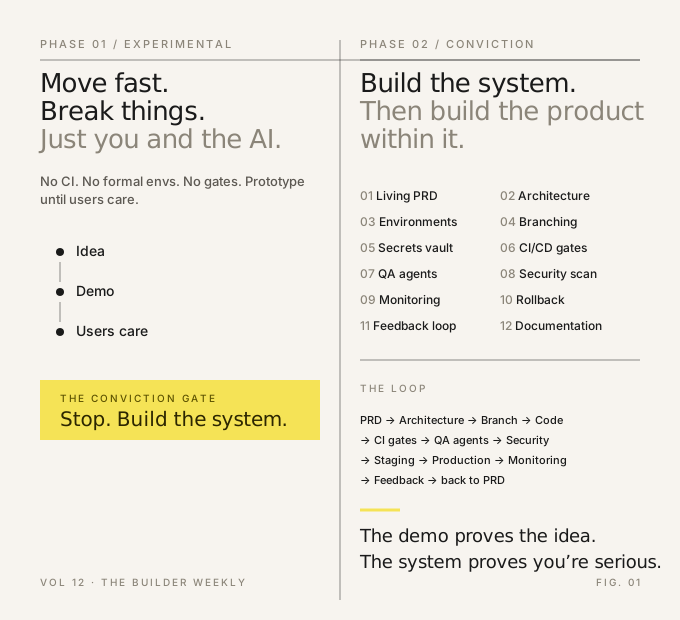
Here is the sequence. How you actually build a system that makes AI production-grade.
1. Start with a living PRD
An MD file with your complete product spec. Not a static doc that gets stale. A living reference that updates after every action.
What you built. What you changed. What is left. What is next.
AI has context. You have history. No more "what did I do last week?"
Update it after every session. Make it the single source of truth.
2. Define your architecture upfront
Before any code. Data models. API structure. Service boundaries. How components talk to each other.
AI can help you design this. But you decide it. This is the skeleton everything hangs on.
Change it later and you are rewriting everything. Get it right early.
3. Set up your environments
Local. Staging. Production. Separate. Always.
Local for building. Staging for testing. Production for users.
Nothing goes straight to production. Ever. This is release discipline. The thing most builders skip when they are moving fast.
4. Create your branching strategy
Main is protected. Feature branches for work. PRs for review.
AI writes the code. The branch structure keeps it organized. No spaghetti. No "which version is live?"
Tag your releases. Know what is deployed. Be able to trace any bug to any commit.
5. Set up secrets management
Vaults for API keys. Credentials. Tokens.
Never hardcoded. Never in repos. Never in plain text.
Key rotation on a schedule. Not when you remember. Automated.
One leaked key can take down everything. This is not optional. This is survival.
6. Build your CI/CD pipeline with gates
Pre-staging checks. Does it build? Does it pass tests? Does it lint?
Post-staging checks. Does it work in a real environment? Do integrations connect?
Production checks. Final gate before users see it.
Automated. No human remembering steps. No human forgetting steps.
Vol 10 callback: Claude Code leaked because a human forgot a manual step. The fix? Automate the step.
We open-sourced how we do this: github.com/govindkavaturi-art/agent-cicd
7. Create QA agents
Not you manually clicking through the app. Agents.
Backend tests. Frontend tests. API tests. Integration tests. Whatever your product needs.
They run automatically on every push. They file bugs directly to GitHub. You wake up to issues logged, not issues discovered by users.
AI builds. Agents test. Humans sleep.
8. Add security scanning
Baked into CI. Not an afterthought.
Every push gets scanned. Dependencies checked. Vulnerabilities flagged. SAST. DAST. Whatever your stack needs.
Security is not a phase at the end. It is a gate at every step.
9. Set up monitoring and alerting
Errors in production should wake you up. Not your users.
Logging. Error tracking. Uptime monitoring. Performance metrics.
Alerts to Slack or wherever you live. Know when something breaks before anyone reports it.
10. Create rollback procedures
Deploys fail. It happens.
One-click rollback. Automated if possible. Know exactly how to undo before you ship.
If you cannot rollback in under 5 minutes, you are not ready for production.
11. Build a feedback loop
User reports. Error logs. Agent outputs. Support tickets.
Feed them back into the PRD. Into the backlog. Into the next iteration.
The system learns. The system improves. Every bug makes the system stronger.
12. Document the system itself
How does CI work? Where are the gates? How do you rollback? Where are the secrets?
When you are at 3am debugging a production incident, you will thank yourself.
This is not bureaucracy. This is survival.
13. Wire it all together
PRD to Architecture to Branch to Code to CI gates to QA agents to Security scan to Staging to Production to Monitoring to Feedback to PRD.
That is the loop. That is the system.
AI executes within this. You designed it. AI runs it. Production stays reliable.
Why this matters
You built the system. Now what?
You ship with confidence. Every push goes through gates. QA agents catch bugs. Security scans flag vulnerabilities. Monitoring alerts you before users notice. You are not hoping it works. You know it works.
Users trust what does not break. Vol 8: trust is the moat. Humans complain. Agents just leave. One silent failure and they are gone. The system prevents silent failures. The system builds trust.
You iterate faster, not slower. This sounds like overhead. It is the opposite. Without a system, every change is scary. Will it break something? Did I forget a step? With a system, you push and the gates tell you if it is safe. Green means go. Red means fix. No guessing.
You can scale. Right now it is you and AI. What happens when you add another agent? Another human? A contractor? Without a system, you are the bottleneck. With a system, the system explains itself. The PRD has context. The CI catches errors. The QA agents test. New contributors slot in without breaking things.
You sleep at night. Production is running. Monitoring is watching. Alerts are set. If something breaks at 3am, you will know. You will have logs. You will have rollback. You are not lying awake wondering if it is still working.
When to build the system
Not on day one. Not for every experiment.
The experimental phase. You have an idea. You want to see if it works. You are validating the vision. This is the demo trap from above. But it is not actually a trap if you know what you are doing. Skip most of the system. Move fast. Break things. Use AI to build a rough prototype. No CI/CD. No QA agents. No formal environments. Just you and Claude figuring it out. This is the right approach. Do not gold-plate an experiment. The demo is how you prove the idea has legs.
The conviction phase. The prototype works. Users are interested. You are sure you are taking this to production. This is when you build the system. Before you add real users. Before you charge money. Before you scale. Stop. Build the system. Then continue. The demo proved the idea. Now prove you are serious.
The cost of skipping. If you skip the system and go straight to production, you will pay later. Silent failures. Leaked keys. Lost users. 3am debugging with no logs. No way to rollback. No idea what broke. You will build the system eventually. The question is whether you do it before or after users get hurt.
And here is the real cost: while you are firefighting broken production, your competitor with a system is shipping features. Capturing users. Taking the market. You moved fast to go slow. They moved deliberately to go fast.
Build it at the conviction phase. Not before. Not after.
The framework
Before you build your next product, ask yourself the ten questions below. If the answer is no to any of them, you are shipping fragile.
- Do I have a living PRD that updates after every action?
- Do I have architecture defined before I write code?
- Do I have environments separated?
- Do I have secrets in a vault with rotation?
- Do I have CI/CD gates that catch failures before users do?
- Do I have QA agents testing and filing bugs?
- Do I have security scanning on every push?
- Do I have monitoring that alerts me before users complain?
- Do I have rollback that works in under 5 minutes?
- Do I have a feedback loop that improves the system?
Build the system first. Then build the product within it.
Vol 1: The opportunity exists. Economics changed. Vol 2: Smart operators doing dumb work. Patterns to spot. Vol 12: AI alone is fragile. Systems make it reliable.
What is your system?
Mike & Govind
Building with AI? Before your next product, build the system. Living PRD. CI/CD gates. QA agents. Security scanning. Monitoring. Rollback. Then build.